


PIP Draft Generator
Convert basic inputs into a complete, professionally worded PIP with SMART goals and consistent HR-ready structure. Exportable as a PDF and built with privacy in mind.
What Is a Performance Improvement Plan?
A Performance Improvement Plan, or PIP, is a formal document that outlines where an employee is underperforming and sets clear, measurable goals for improvement. It helps HR teams and managers create a more transparent, objective, and documented process.
To make the process easier, access the PIP Draft Generator above to create a structured Performance Improvement Plan your organization can download, customize, and review before sharing.
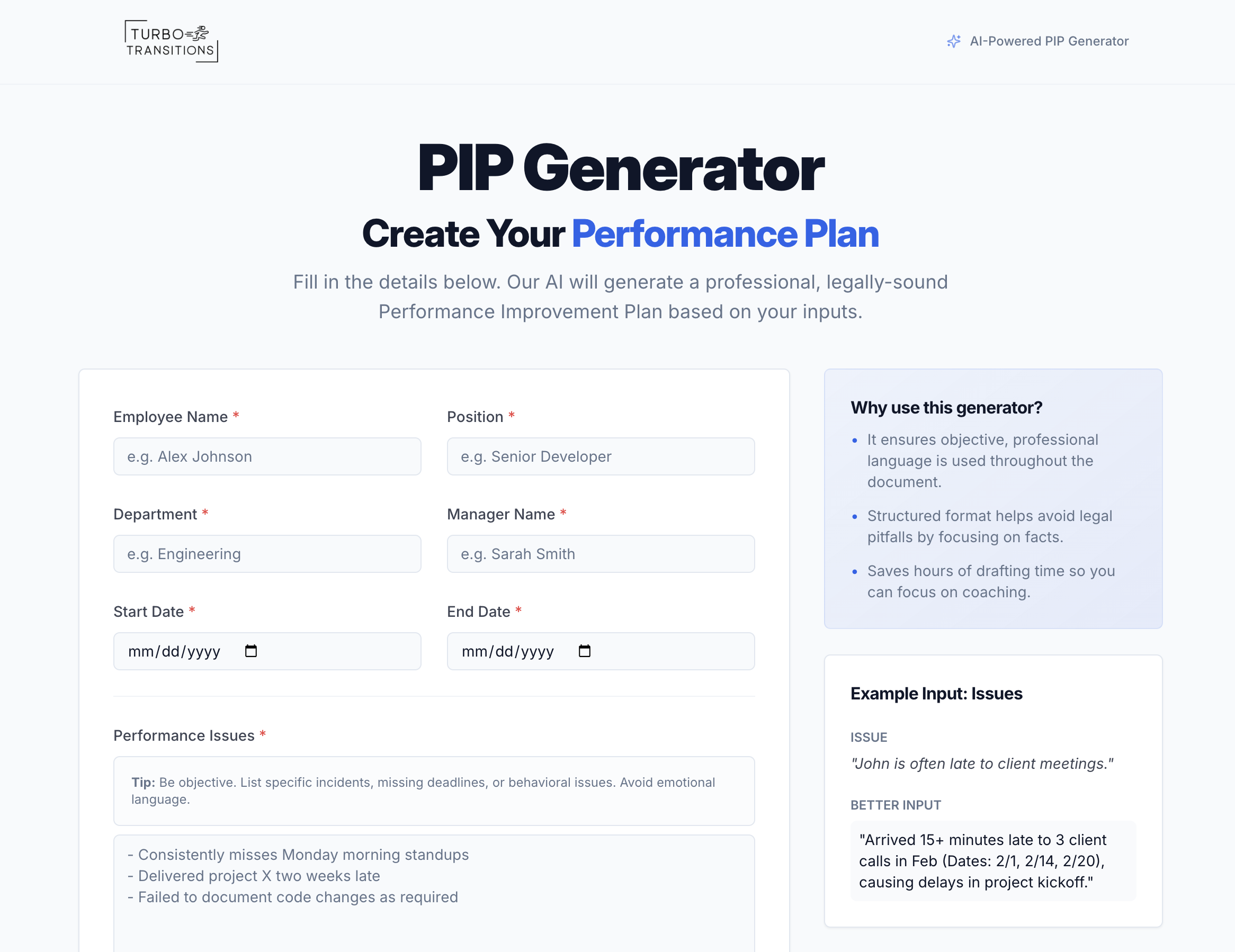
PIP Generator (AI-Powered Performance Improvement Plan)
What it does:
The Turbo PIP Generator is a web-based tool that helps HR professionals and managers quickly create formal, professionally written Performance Improvement Plans. Users simply fill in basic employee details — name, position, department, manager, dates, performance concerns, and desired outcomes — and the tool uses advanced AI to transform that input into a comprehensive, legally-sound PIP document.
The generated document includes structured sections like Purpose, Specific Deficiencies, Measurable Goals, Support Resources, Review Schedule, and Consequences. It can be copied as text or downloaded as a PDF for immediate use.
How it works:
A manager fills out a short form with the employee's information and describes the performance issues and expected improvements in plain language. The tool sends that information to an AI engine, which analyzes the input and generates a complete, professionally formatted PIP document in about 15–30 seconds.
The AI applies best practices like SMART goal criteria, role-appropriate expectations, and constructive but firm legal phrasing. The finished document is displayed on screen, where it can be reviewed, copied, or downloaded as a PDF. No data is stored permanently — the document is held temporarily for 30 minutes and then automatically deleted, protecting sensitive employee information.
Why it's beneficial for HR professionals:
Writing a PIP from scratch is time-consuming and requires careful attention to legal language, measurable goals, and professional tone — skills that not every manager has readily available. This tool dramatically reduces that burden by turning a few bullet points into a polished, structured document in seconds.
It ensures consistency across the organization, so every PIP follows the same professional standard regardless of which manager creates it. The AI also helps avoid common pitfalls like vague language, unmeasurable goals, or punitive tone, producing documents that are more defensible and constructive. And because no employee data is saved, HR teams can use it with confidence that sensitive personnel information stays private.

Why a Performance Improvement Plan Is Essential
Performance issues aren’t just management challenges - they’re documentation events. A well-built PIP creates clarity for the employee, consistency for HR, and a defensible record for the organization if performance doesn’t improve.
Most importantly, it turns an emotional, subjective situation into a structured improvement plan with measurable expectations and documented follow-through.
What a Strong PIP Should Include
A PIP isn’t just a warning, it’s a formal roadmap that defines what needs to change and how success will be measured. The strongest plans include: a clear purpose and success definition, specific performance deficiencies with concrete examples, measurable goals (ideally aligned to SMART criteria), support/resources the company will provide, a defined check-in schedule, and a clear explanation of consequences if improvement is not achieved.
Common PIP Mistakes That Create Risk
Most PIPs break down because they’re vague, inconsistent, or incomplete. Common pitfalls include unclear expectations (“be more proactive”), missing examples or documentation, unrealistic timelines, lack of support resources, and tone problems (either overly harsh or so soft it weakens accountability).
These issues make PIPs harder to execute, easier to dispute, and less useful if decisions are later reviewed.
Why HR Teams Need Standardization
Even strong managers often struggle to write high-quality PIPs, and the quality can vary widely across departments. Standardization reduces bias, supports fairness, and creates a repeatable process that’s easier to manage and audit. A consistent structure also helps managers stay focused on measurable outcomes and keeps performance actions aligned across teams.
PIPs and HR Risk Considerations
A PIP isn’t legal advice, but it often intersects with higher-risk HR situations—especially when timing is sensitive or when decisions may later be scrutinized.
Clear documentation matters most when there are concerns around inconsistent treatment, retaliation allegations, protected class issues, accommodation needs, remote performance visibility, or terminations following unclear expectations.
A well-written, well-timed PIP doesn’t remove risk, but it significantly improves clarity, fairness, and defensibility when reviewed with HR and counsel.
How the Turbo PIP Generator Works
The Turbo PIP Generator turns manager notes into a complete, professionally structured PIP in minutes.
You enter the employee’s role details, performance concerns, and desired outcomes in plain language, and the tool generates a structured document with standard sections like Purpose, Specific Deficiencies, Measurable Goals, Support Resources, Review Schedule, and Consequences. You can review the draft on screen, then copy it or export it as a polished PDF—without storing employee data long-term.
When to Use a PIP (and When Not To)
PIPs are best used when expectations are clear, the issue is performance-based (quality, output, deadlines, communication, reliability), and the employee has a realistic path to improvement with appropriate support.
They may not be appropriate for serious misconduct, policy violations requiring immediate action, or situations where an accommodation/leave issue needs to be addressed first. When in doubt, HR and counsel should guide the decision, especially in complex cases.

“Take care of your employees and they’ll take care of your business.”
— Richard Branson, Founder of Virgin Group
Frequently Asked Questions (FAQ)
1) What is a Performance Improvement Plan (PIP)?
A PIP is a formal, written plan that documents performance concerns and lays out clear expectations for improvement. It typically includes specific deficiencies, measurable goals, support/resources, a review schedule, and what happens if improvement doesn’t occur. A strong PIP is both a coaching tool and a documentation tool.
2) Is a PIP meant to help someone improve or to document termination?
Ideally, both—because clarity and documentation aren’t mutually exclusive. A well-run PIP should give the employee a real chance to succeed with clear goals and support. At the same time, it creates a consistent record of expectations and progress in case the role ultimately isn’t a fit.
3) When should HR use a PIP vs. a coaching plan?
Use a coaching plan when the issue is early-stage or mild and you expect quick correction with informal guidance. Use a PIP when performance gaps are recurring, material to the role, or have already been discussed informally without sustained improvement. A PIP is also appropriate when you need a formal structure with documented milestones and timelines.
4) How long should a PIP last?
Most PIPs run 30, 60, or 90 days, depending on the role and the type of performance issue. Shorter timeframes can be appropriate for urgent, measurable issues (attendance, deadlines). Longer timeframes can be necessary when improvement requires skill-building, training, or behavioral change.
5) What should be included in a strong PIP?
A defensible PIP usually includes:
Purpose and expectations of the role
Specific deficiencies with examples
Measurable goals (SMART-style)
Support/resources and manager responsibilities
Check-in cadence (weekly/biweekly)
How progress will be measured
Consequences if improvement isn’t met
Acknowledgment/signature section (where appropriate)
6) How specific do PIP goals need to be?
Very specific. “Improve communication” is too vague. “Send a weekly project update by 3pm Friday with status, blockers, and next steps” is measurable. The more measurable the goal, the less disagreement you’ll have later about whether improvement occurred.
7) What are SMART goals, and do PIPs have to use them?
SMART goals are Specific, Measurable, Achievable, Relevant, and Time-bound. You don’t have to label them “SMART,” but the goals should function like SMART goals—clear outcomes, clear measurement, and clear timing.
8) Should a PIP include examples of poor performance?
Yes—carefully and factually. Include dates, observable behaviors, and impact (missed deadlines, quality errors, customer complaints), not opinions or character judgments. Clear examples reduce “surprise” and improve fairness.
9) Can an employee be terminated while on a PIP?
Yes, depending on company policy and the situation. Termination might be appropriate if there’s new misconduct, severe performance failure, or the employee clearly isn’t meeting minimum standards during the PIP period. HR should align with leadership and (when needed) counsel, especially in higher-risk situations.
10) Do employees have to sign a PIP?
It depends on your policy and local practices. Many employers use signatures to confirm receipt, not agreement. If an employee refuses to sign, document that they received it (e.g., “employee declined to sign; copy provided on [date]”) and proceed with the plan.
11) What tone should a PIP be written in?
Constructive, direct, and professional. Avoid emotional language, sarcasm, labels (“lazy,” “unmotivated”), or threats. The tone should communicate seriousness while focusing on clear expectations and support.
12) How often should managers check in during a PIP?
Weekly check-ins are common because they create momentum and documentation. Some roles may warrant twice-weekly touchpoints early in the PIP. Regardless of cadence, document each check-in briefly: what improved, what didn’t, and next steps.
13) What documentation should HR keep during a PIP?
Keep the PIP document, meeting notes, performance examples, goal tracking evidence (work output, metrics, QA results), training/support provided, and a short summary after each check-in. Consistent documentation is what makes a PIP credible and easier to manage.
14) What are common reasons PIPs fail (even with good intentions)?
Usually one of these:
Goals aren’t measurable
Timelines are unrealistic
Support isn’t actually provided
Manager doesn’t hold consistent check-ins
The role expectations were unclear from the start
The issue is not “fixable” via coaching (wrong fit)
15) Is a PIP considered a disciplinary action?
Often yes, in the sense that it’s a formal corrective step. However, it can still be positioned as an improvement plan rather than punishment. The key is fairness: clarity, support, and consistent follow-through.
16) How do you handle accommodations or medical issues during a PIP?
If there’s any indication the issue may involve a medical condition or disability, HR should pause and follow the company’s accommodation process (interactive dialogue, documentation as required, reasonable accommodation assessment). A PIP can still be used, but expectations may need adjustment to be fair and compliant.
17) How should HR handle PIPs for remote employees?
Remote PIPs should be even more explicit about expectations and measurement. Focus on outputs, deadlines, quality, responsiveness standards, and meeting participation—not “visibility.” Build in clear communication norms and tracking so there’s no ambiguity.
18) What’s the difference between a PIP and progressive discipline?
Progressive discipline is a broader framework (verbal warning → written warning → final warning → termination, etc.). A PIP is one possible step within that framework, typically used when the problem is performance-related and needs structured goals and follow-up.
19) Can a PIP be used for behavioral issues (not just performance)?
Yes, if the behaviors are work-related and can be defined and measured (professional communication, attendance, collaboration norms). The trick is to convert behavior expectations into observable, measurable standards and document examples without editorializing.
Wrapping Up | Performance Improvement Plan Generator
Performance management is one of the hardest areas in HR because it blends people, fairness, and risk. The Turbo PIP Generator helps you handle it with clarity and consistency by producing a structured, measurable plan that documents expectations, support, and outcomes.
Instead of drafting from scratch or relying on inconsistent manager writing, you get an HR-ready PIP draft in minutes that’s easy to review, refine, and share.

Disclaimer
Disclaimer. These tools and their outputs are for informational purposes only and are not legal, compliance, financial, tax, or HR advice; using them does not create an attorney–client or advisory relationship. Laws vary and change—always review results with your legal, benefits, and HR advisors before acting.
Data & access. By default we don’t store personally identifiable information you enter. Each tool is unlocked per page with your work email so we can send exports/resources and optional help; one tool’s email doesn’t unlock others, and you can unsubscribe anytime. If you choose Save, your project is stored securely and auto-deleted after {{X}} days; you can request deletion anytime at contact@turbotransitions.com.
Privacy & security. We use commercially reasonable safeguards, but no method is 100% secure. For saved projects you remain the data controller and we act as a processor under your instructions. You’re responsible for reviewing outputs before sharing and for controlling access to shared links/PDFs/CSVs. We may use de-identified, aggregated usage data to improve the tools; we do not sell personal data.
Scope, third parties & liability. Outputs are generic/non-jurisdictional and may not be complete or current; compliance-adjacent items include “verify with counsel” reminders. Linked third-party sites (e.g., carriers/HRIS) have their own policies—we’re not responsible for their content or security. Services are provided as is/as available with no warranties; to the extent allowed by law, we’re not liable for indirect or consequential damages.
Tags: performance improvement plan (PIP), PIP template, how to write a performance improvement plan, performance improvement plan examples, PIP process for employees